
Case Study: AI Training for the HR Division of Fujitsu Limited

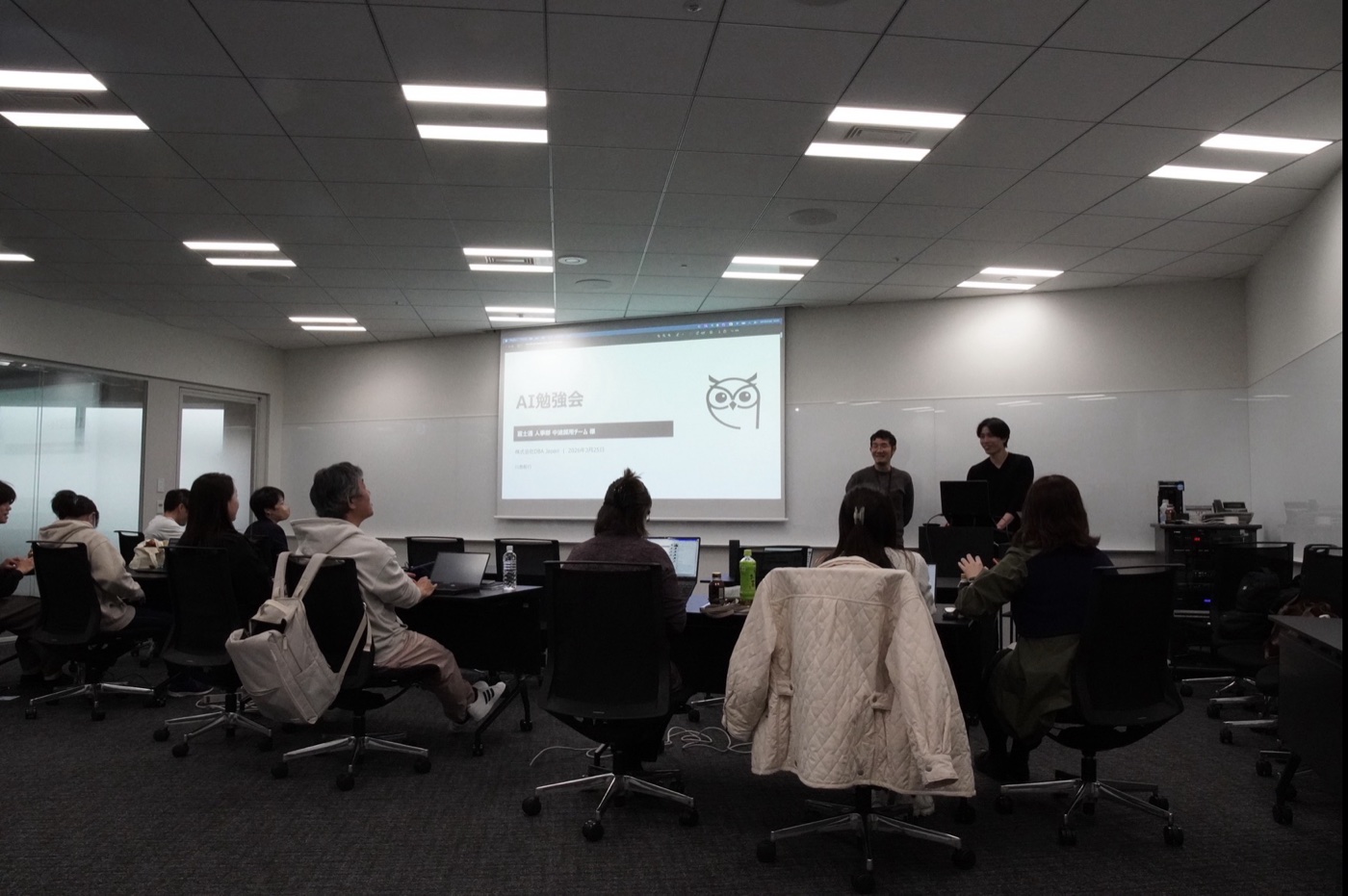
For the HR division: 6 side-by-side AI training sessions,
plus 1 standard AI training session for 20 people.
Average resistance to AI
fell by nearly half.
Resistance to AI (14 participants, 10-point scale, lower is better)
All 10 participants who started with high resistance saw it drop.
Participants who got worse: zero.
Pre- and post-training surveys, 14 participants (10-point scores). Average 4.14 → 2.36 (−43%)
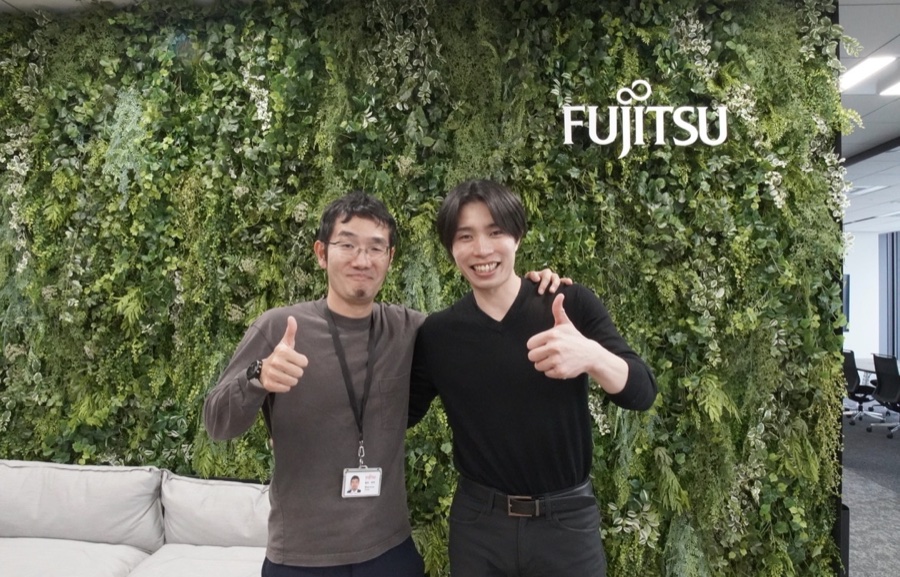
“AI isn’t something to fear. It’s something to enjoy.”
Yohei Matsumura · HR Compliance Office, Fujitsu Limited
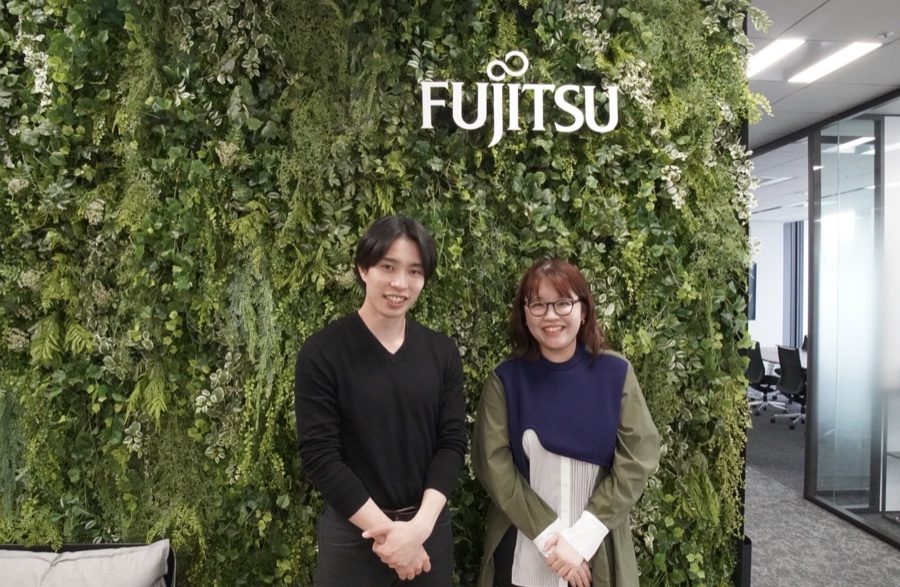
“Hearing it from a person is what finally made it click.
Being able to hear a real, firsthand voice makes a huge difference.”
Nao Sakaguchi · Talent Acquisition Center, Fujitsu Limited
All 14 participants said
they would recommend it.
9.57
Average willingness to recommend (14 participants)
Would you recommend it to colleagues and friends?
0 people
said they would
not recommend it
Asked “Would you recommend this study session to colleagues and friends?”, participants gave a 9.57 average willingness to recommend (14 participants, Google Forms). Zero answered that they would not, and 3 gave the highest possible rating.
After the training, a participant paid for Claude Code
entirely on their own initiative.
In the free-response section of the post-training survey, one participant wrote: “I went ahead and paid for Claude Code and started using the Pro plan.” It was not a company instruction. It was their own decision.
Interview
It wasn’t “training.”
It was someone running alongside us.
From “I have no idea what generative AI can even do” to actually using it in daily work, and continuing to. We asked Mr. Matsumura and Ms. Sakaguchi, who were part of the program, how that change came about.

It started with the feeling: “this person actually does the work”
To start, looking back at that time: why did you decide to reach out to me?
The premise was already there: we knew we had to start using AI. Within our recruiting work, I kept wrestling with how to bring AI in, and how to create that first opening.
Looking through all the posts and news out there, a lot of it felt like people saying nice-sounding things about AI, and it never quite landed with me.
Then I came across your LinkedIn posts and thought, “these are the posts of someone who actually does this.” Because the tips came from real use, they spoke directly to our work on the hiring side, and it felt grounded, feet firmly on the ground. That caught my interest, so I reached out.
From “I’ve heard of ChatGPT” to a whole new way of engaging with AI
Ms. Sakaguchi, on the initial intake sheet you wrote, “I can’t picture what AI can actually do.” Now that some time has passed since the training, how have things changed?
I think I have changed. Before the training, I was at the level of having heard of ChatGPT. I would play with it a little, but that was about the extent of it (laughs).
But I realized there is truly so much AI can do. I used to think AI was something that handed everything back in a single exchange. It isn’t. A mindset took root in me that AI is something you nurture and grow.
I feel I learned not just how to use AI, but how to engage with it.
Not training. Running alongside us.
Mr. Matsumura, you once told me, “that was really consulting.” What did you mean by that?
More than “consulting,” I think the closer expression for what we did is “running alongside us.” You didn’t teach AI at a surface level. You engaged with the underlying problems first, and taught AI on top of that understanding. Rather than delivering a training program, it felt like you searched out our problems with us and cleared them one by one, and our progress kept accelerating.
To put it another way, not a consultant but a running partner. Same eye level, same pace, simply showing us how to take the next half step, the next full step. You didn’t apply some ready-made plan from the start. You designed it only after properly understanding our situation.
Ms. Sakaguchi, from your side, does “running alongside” feel accurate too?
It did feel like you ran alongside us. You stayed close. You met us at our eye level, but without lowering yourself all the way to it: you showed us the half step ahead and gave us a genuinely higher vantage point. That made a big difference.
Why video courses never got through
There are plenty of video courses and seminars out there. What made this approach different?
The biggest difference is the stance. Seminars and video courses tend to speak from the position of the one doing the teaching. From our side, it never feels like they come all the way over to where we are.
You began by standing on our side and understanding us. It was less about delivering something and more about moving forward together. That was the decisive difference.
That is why some members of the recruiting team ended up subscribing to the paid version of Perplexity, and others started trying Claude. They felt they could give it a go precisely because that stance was there.
With generic, pre-packaged content, it is hard to make it your own. This time, it was designed around our environment and our level of knowledge.
We were in a state of “we probably have to use AI, but we have no idea where to start.” The side-by-side approach fit that state remarkably well.

The moment “AI can do this” became visible in an instant
There was that moment when you built a macro with AI. What did it feel like, the instant you realized AI could take you that far?
In my first year, my manager once ran a macro study session for us. He even bought us textbooks, and I tried building one myself for the work I had at the time. But I remember it taking a long time, and after that, writing a macro never crossed my mind again.
With AI, it was done in an instant. And it actually worked. That, quite simply, was moving.
Honestly, my reaction was something like, “if it’s this quick, lucky me.” There were no mixed feelings at all. Mostly I just felt grateful.
Why it kept going for seven sessions
Counting the pre-training meetings and the practice-style sessions, you gave me a great deal of your time. With schedules as busy as yours, what was the single biggest reason you kept going?
The biggest was our sense of the problems in our recruiting work at the time. We felt recruiting itself needed to change, and that bringing in technology like AI could make it better.
That was for my own sake, and for the team’s. So I pulled Sakaguchi in, and had other members join as well.
The other reason is that it was simply fun. Part of it is that I like new things, but every time we met, you gave us some kind of spark. That was fun.
And your enthusiasm was remarkable. Where most people would say “here is the program, this is what we will run,” you came back to face us again and again. We were glad, and grateful. If anything, it feels closer to say we were the ones allowed to keep going.
Working in parallel with AI
Since the training, does it feel like AI has genuinely taken root in your day-to-day work?
For me, I believe it has. Looking at the team as a whole, part of me feels we are not all the way there yet, but there are definitely people using it.
For example, document preparation now takes far less time. I feed in rough, unformatted notes and it shapes them into a proper document. Being able to work on something else in the meantime is huge. For researching outside information too, using Copilot, GPT, and Claude together, I feel the quality has gone up as well.
And you, Mr. Matsumura?
My role changed, so a simple comparison is not possible, but these days I work in the pattern of “have it build the deck while I do something else,” or “have it run the research while I push my own work forward.”
I now operate with a “me plus Copilot” mindset, as an addition to myself. By feel, the share of my work where I use AI has doubled or tripled. It has become a given, almost like infrastructure.
Just today, I realized I had not prepared the materials for my morning meeting. So I spent two or three minutes giving instructions to Copilot in Word and let it draft them, and used those ten minutes to move other work forward. The fact that my mind now jumps there immediately is one of the bigger changes.

Without AI, the workload might have overwhelmed us
In the first hearing, you also said you wanted to spend time on work only humans can do. Is that starting to become reality?
We are still on the way. Without AI, I honestly think we would have been overwhelmed. With limited time and limited people, I feel AI is what keeps everything holding together. Still mid-journey, but I can now keep things turning within my own capacity.
The high marks reflect the whole journey, not a single session
In the post-training survey, all 14 participants answered that they would recommend it to colleagues and friends. Honestly, my own reaction was, “can that really be true?” Mr. Matsumura, how do you read that result?
No major surprise on my end. I don’t see those marks as a rating of one single session.
You were involved with us six or seven times before the training itself, and the members joined the session already knowing you to some degree. I think the marks reflect that entire body of engagement.
Some people saw potential in voice input. Others noticed the differences between the various AI tools. It reached places you cannot get to just by reading articles. There is surely room to improve, but I don’t feel the number is far off.
Ms. Sakaguchi, how did it strike you?
It feels about right to me. In a fixed two-hour session, it is hard to leave every person fully happy with every part. But you packed so many essential pieces into it. And on top of that, you pitched it to our level, the level of people who simply didn’t know. So everyone came away with at least one thing that hooked them, and for many people it stuck.
Talking with a person, not text or video, is what brought things into focus
What would you say to people who are hesitating to start with AI, or who feel it is not for them?
I myself fundamentally did not understand what AI was, or even where to begin trying to understand it.
But by talking through concrete things with you, I came to know what text and video alone could never show me. The picture sharpened enormously.
Unless you are already deeply interested, taking that first step through text and video alone is hard. So the value of learning from a person, of having someone actually show you, of making time to talk face to face: I think that really mattered.
AI went from “something scary” to “something to be excited about”
Finally, if you had to sum this program up, what kind of period was it?
A fun one. My thinking changed enough that ten years from now, I expect to look back on it as a turning point, for my work and my life outside it. I have real conviction that what you did for us was genuinely worth it.
That it stayed enjoyable mattered too. Looking back, it was full of stimulation, and I could feel it feeding my own growth. I think that is exactly why it was fun.
For me too, the feeling is fun. I went from a vague unease and worry about AI to seeing it as something that can change my work and my life, a shift toward something I can genuinely be excited about.
I believe this program was the trigger.

Frequently Asked Questions
How was the side-by-side AI training at Fujitsu rated?
In the post-training survey, the question “Would you recommend this to colleagues and friends?” received a 9.57 average willingness to recommend (14 participants, Google Forms), and zero participants answered that they would not. Resistance to AI fell 43% (average 4.1 to 2.4), and no participant became more negative.
How did resistance to AI change through the training?
On a 10-point scale, resistance to AI fell 43% (average 4.1 to 2.4). All 10 participants who started with high resistance saw it drop, and no participant became more negative.
What makes side-by-side AI training different from a standard training program?
Rather than one-way instruction in generative AI tools, we start with a pre-training hearing to understand each company’s specific work challenges and current level of understanding, then design the support so that people keep using AI on the job after the training ends. Learn more on the side-by-side AI training page (Japanese).
Did AI actually take root in day-to-day work after the training?
After the training, a participant signed up for a paid generative AI plan (Claude Code) on their own initiative. AI is now part of daily work, including faster document preparation.
What was the scale and which division took part? Are Japanese training subsidies available?
For roughly 20 people in the HR division of Fujitsu Limited, we delivered 6 side-by-side AI training sessions plus 1 standard AI training session for 20 people. Programs can also be designed to qualify for Japan’s Human Resources Development Support Subsidy (AI training subsidies (Japanese) / pricing (Japanese)).
More Case Studies